For paint removal that won’t leave you exhausted, you’ll want the Makita 9403 belt sander—it’s a powerhouse at 1,640 ft/min and surprisingly quiet at 84dB. If you’re tackling curves or detail work, perhaps reflect on the TECCPO Detail Sander with its 14,000 orbits per minute. We think variable speed control is essential, especially for beginners who might gouge the surface. Random orbital sanders offer more versatility than belt sanders, though they’re less aggressive on stubborn paint layers. There’s much more to ponder when choosing your ideal tool.
Some of the links in this article may be affiliate links. If you make a purchase through these links, we may earn a small commission at no extra cost to you. Thank you.
Best Overall Sanders for Paint Removal
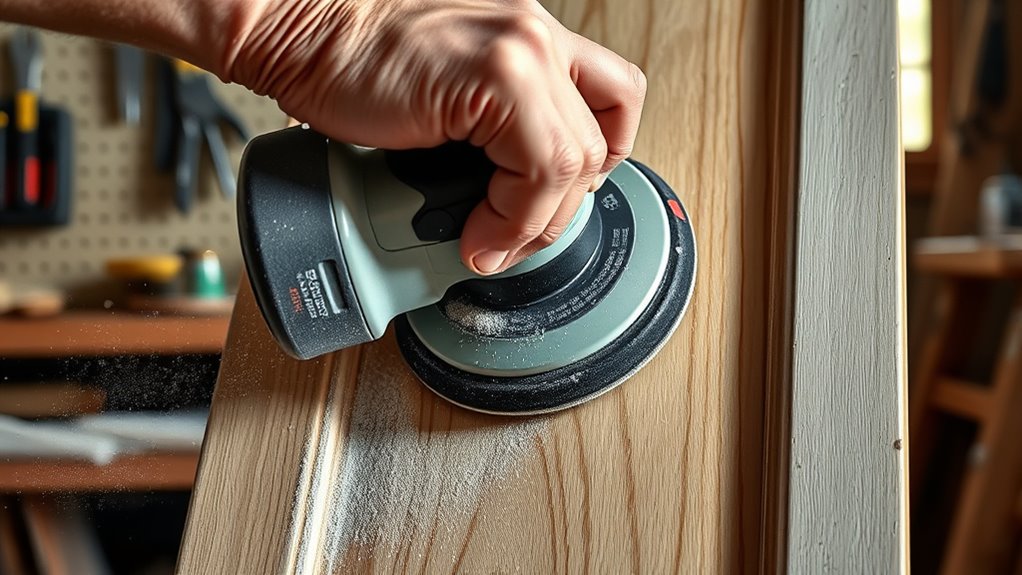
Finding the right sander for paint removal can feel overwhelming when you’re staring at rows of power tools, but a few standouts consistently deliver the performance most DIYers and professionals need.
The Makita 9403 belt sander tops our list, though it’s perhaps not the cheapest option. Its 4-inch belt runs at 1,640 ft./min while maintaining a surprisingly low 84dB noise level.
The Makita 9403 delivers professional-grade performance with its fast 4-inch belt and impressively quiet 84dB operation.
We think the labyrinth construction really sets it apart for dust protection.
The TECCPO Detail Sander offers solid value at 14,000 orbits per minute. It’s lighter at 2.6 pounds, making extended use more comfortable.
Essential Features to Consider When Choosing a Paint Removal Sander
While these top sanders deliver impressive performance, the specific features matter more than brand names when you’re actually using the tool for hours at a time.
Speed control is probably the most vital feature—we think beginners especially need this to avoid gouging wood. You’ll want to start slow and gradually increase power as you get comfortable.
Dust collection makes a huge difference in your working environment, though most dust bags are somewhat porous anyway.
A comfortable grip becomes essential during extended sessions, and perhaps variable speed prevents overheating your sandpaper.
Belt Sanders: Power Tools for Large Flat Surfaces
When you’re tackling large, flat surfaces like cabinet doors or tabletops, belt sanders become the obvious choice—though they’re definitely not the most forgiving tools in your arsenal.
The Makita 9403 stands out here, perhaps because it runs surprisingly quiet at 84dB while moving its belt at 1,640 feet per minute.
We think what makes belt sanders tricky is their aggressive nature. You can gouge wood faster than you’d expect if you apply too much pressure.
Variable speed control helps, but honestly, they’re still not great for vertical work. For heavy paint removal though, nothing matches their efficiency on horizontal surfaces.
Random Orbital Sanders: Versatile Options for Most Projects
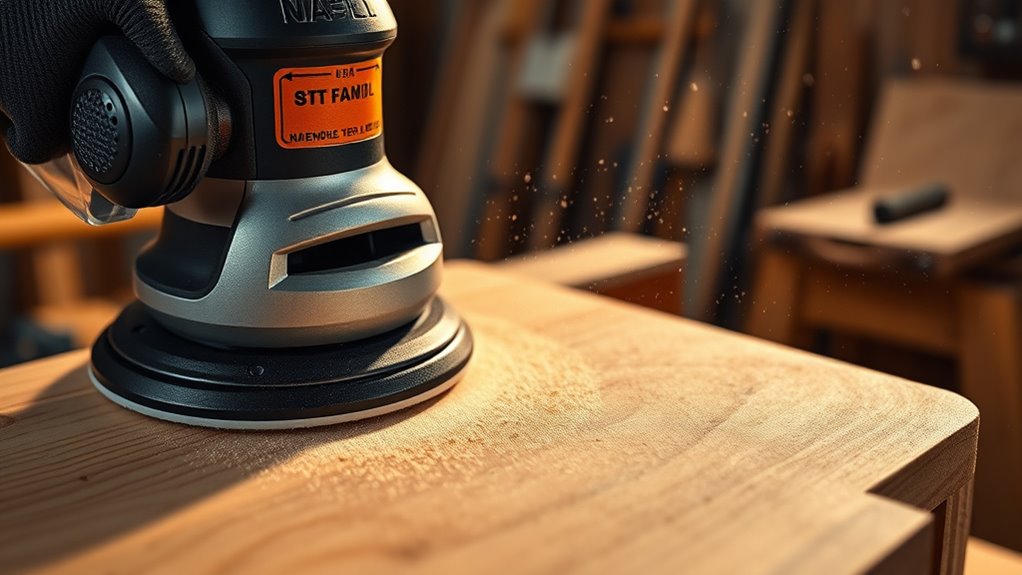
Since most paint removal projects involve curved surfaces, corners, or varying angles, random orbital sanders have earned their reputation as the go-to choice for most DIYers.
They’re lighter than belt sanders and won’t leave those aggressive scratch marks that can ruin your finish.
We think what makes them particularly appealing is their versatility. You can handle furniture refinishing one day, then tackle deck railings the next.
Perhaps most importantly, they’re forgiving for beginners.
Random orbital sanders offer a gentle learning curve that builds confidence while delivering professional results even for first-time users.
- Variable speed control prevents gouging delicate surfaces
- Hook-and-loop disc system makes sandpaper changes quick
- One-handed operation allows better maneuverability around obstacles
- Effective dust collection keeps your workspace cleaner
- Swirl-free finish eliminates extra prep work
Detail Sanders: Precision Tools for Tight Spaces and Intricate Work
The triangular head of a detail sander might look unusual compared to other power tools, but it’s specifically engineered to tackle those frustrating areas where regular sanders simply can’t reach.
You’ll find these sanders invaluable when working around spindles, corners, or decorative molding where paint tends to accumulate.
The BLACK+DECKER Mouse Detail Sander stands out here, though we think its dust collection could be better.
At 16,000 orbits per minute, it’s surprisingly aggressive for such a compact tool.
The detail finger attachment is perhaps the most useful feature – you can actually get into grooves that seemed impossible before.
Heavy-Duty Sanders for Professional Paint Stripping Jobs
Professional contractors and serious DIYers eventually encounter jobs that’ll make a regular orbital sander cry for mercy – think multiple layers of lead paint on old Victorian trim or industrial coatings on commercial surfaces.
These demanding projects require sanders built like tanks.
The Metabo HPT Belt Sander stands out with its 9 Amp motor and variable speed control.
Perhaps it’s overkill for weekend projects, but when you’re stripping paint from entire decks, you’ll appreciate the power.
- 9 Amp motor handles the toughest paint removal jobs
- Variable speed prevents surface damage on delicate materials
- Toolless belt changes keep you working efficiently
- Dual dust collection (bag plus vacuum port) maintains visibility
- Ergonomic grip reduces fatigue during extended use
Battery-Powered Sanders: Cordless Freedom for Any Location

Power tools tethered to outlets can turn into a real headache when you’re working on outdoor furniture, second-story trim, or anywhere an extension cord becomes more trouble than it’s worth. That’s where battery-powered sanders shine, offering genuine freedom to tackle paint removal projects anywhere.
The DEWALT 20V MAX stands out as perhaps the best cordless option, though you’ll need to buy the battery separately. Its brushless motor delivers impressive runtime, and we think the variable speed control really makes a difference.
| Feature | DEWALT 20V MAX | Standard Corded |
|---|---|---|
| Portability | Excellent | Limited |
| Runtime | Battery dependent | Unlimited |
| Power | Very good | Superior |
| Convenience | High | Moderate |
Specialized Paint Removal Tools and Hybrid Systems
Sometimes regular sanders just can’t handle the job you’re throwing at them, and that’s where hybrid systems like the BOSCH GET75-6N really start to make sense.
These tools combine multiple sanding modes in one unit, giving you more versatility without buying separate sanders.
The turbo mode on hybrid systems delivers perhaps three times the stock removal of standard random orbit sanders. We think that’s where these tools really shine – when you’re dealing with stubborn paint layers.
- Dual-mode operation switches between gentle finishing and aggressive removal
- Multi-hole pad systems accommodate various disc types and grits
- Enhanced dust collection keeps your workspace cleaner than traditional sanders
- Counterweight systems reduce vibration and hand fatigue during extended use
- Variable speed controls let you match the tool’s power to your specific task
Frequently Asked Questions
How Much Should I Expect to Spend on a Quality Paint Removal Sander?
Don’t break the bank, but quality paint removal sanders range from $50-300. You’ll find decent random orbital sanders around $80-150, while premium belt sanders like the Makita 9403 cost more but deliver superior performance.
What Safety Equipment Do I Need When Using Sanders for Paint Removal?
You’ll need safety glasses, a dust mask or respirator, and hearing protection. Wear work gloves to protect your hands and guarantee good ventilation since paint dust can contain harmful particles.
How Do I Properly Maintain My Sander to Extend Its Lifespan?
Like nurturing a faithful companion, you’ll extend your sander’s life by regularly cleaning dust from vents, replacing worn brushes, lubricating moving parts, storing it dry, and checking cords for damage before each use.
Can Sanders Remove Multiple Layers of Paint in One Pass?
You can’t remove multiple paint layers in one pass. You’ll need several passes with progressively finer grits. Start with coarse sandpaper, then work through medium to fine grits for best results.
What Grit Sandpaper Should I Start With for Thick Paint Removal?
Picture layers of stubborn paint clinging like bark to wood. You’ll want to start with 60-80 grit sandpaper for thick paint removal, then progress to finer grits for smoothing the surface afterward.
Related guides: Wood Stain Vs Paint · Polyurethane Over Paint · How To Paint A Deck With Peeling Paint