As an Amazon Associate, we earn from qualifying purchases. Some links in this article are affiliate links.
Some of the links in this article may be affiliate links. If you make a purchase through these links, we may earn a small commission at no extra cost to you. Thank you.
We’ve spent countless hours researching and testing lathes for woodworking beginners, and we’re excited to share our findings with you. Starting out in woodturning can be overwhelming—there’s so much equipment to choose from, and making the wrong choice might derail your enthusiasm before you’ve even begun. The right lathe should balance quality, ease of use, and value without breaking the bank. Wondering which models actually deliver on their promises? Let’s look at what makes these five stand out from the crowd.
WEN 34035 6-Amp 14-Inch by 20-Inch Variable Speed Benchtop Wood Lathe
No products found.
For woodworking newbies looking to start their turning journey, the WEN 34035 benchtop lathe offers the perfect balance of functionality and simplicity. We’re impressed by its versatile 250-3550 RPM range, making it suitable for virtually any turning project you might tackle as you develop your skills.
What really stands out, though, is how beginner-friendly this machine is. The included 4-inch faceplate is perfect for turning those first bowls and cups, while the 8-inch tool rest provides stability when you’re still mastering tool control. And don’t worry about accessories—the MT2 tapers and 1-8 spindle thread mean you won’t outgrow this lathe quickly as your collection expands.
Best For: Beginner woodturners seeking an affordable, versatile benchtop lathe with enough features to support their skill development from basic spindles to more advanced bowl turning projects.
Pros:
- Variable speed range (250-3550 RPM) accommodates a wide variety of turning projects and wood types
- Comprehensive accessory package includes everything needed to start turning immediately (faceplate, centers, tool rest)
- Industry-standard MT2 tapers and 1-8 spindle thread ensure compatibility with future accessory purchases
Cons:
- 14-inch width capacity may limit larger bowl turning projects as skills advance
- 6-amp motor might struggle with harder woods or when taking aggressive cuts
- Benchtop design may require additional stabilization for heavier or unbalanced workpieces
Mini Lathe Wood Lathe Machine Multi-Purpose Professional Table Top Kit
No products found.
Beginner woodworkers with limited space and smaller project aspirations will find the Winbomgo Mini Lathe Wood Lathe Machine a surprisingly versatile addition to their workshop. Weighing just over 4 pounds and measuring about 14 inches long, it’s perfect for cramped spaces while still delivering impressive functionality.
We’re particularly impressed by the 7 adjustable speeds (3500-10000 rpm) which give you plenty of control for different projects. The 100W motor runs quietly at just 50 dB—you won’t wake the neighbors! It’s not, well, it’s not going to handle large bowls or table legs, but for small decorative items like pens, beads, and finials, it’s actually quite capable. The included four-jaw chuck and accessories help you get started right away.
Best For: Beginner woodworkers and hobbyists with limited space who want to create small decorative items like pens, beads, and finials without investing in a full-sized lathe.
Pros:
- Compact and lightweight (4.18 pounds) design makes it ideal for small workspaces
- Seven adjustable speed settings (3500-10000 rpm) provide versatility for different projects
- Quiet operation (50 dB) and included accessories (four-jaw chuck, saw blade, turning tool) make it ready to use out of the box
Cons:
- Limited capacity prevents working on larger projects like bowls or table legs
- 100W motor may lack power for harder materials or more demanding applications
- Some users report issues with stability and tool rest positioning during operation
Mini Lathe Wood Lathe Machine, Multi-Purpose for Wood Polishing & Milling
No products found.
Compact and powerful, the BACHIN Mini Lathe Wood Lathe Machine stands out as an excellent entry point for DIY enthusiasts who want to explore woodworking without dedicating an entire workshop to their new hobby. At just under 5 pounds with dimensions of 2.76 x 6.3 inches, it’s remarkably space-efficient.
We’re impressed by its versatility—this little powerhouse handles everything from wood polishing to milling with its 7-speed motor (up to 11000 RPM!). The aluminum alloy construction provides surprising stability for such a compact tool. While the included HSS tools are, well, adequate for beginners, you’ll probably want to upgrade them eventually. For around $100, it’s hard to find a more complete starter package.
Best For: DIY enthusiasts and hobbyists seeking an affordable, space-saving introduction to woodworking without committing to a full-sized lathe.
Pros:
- Extremely compact and lightweight (4.97 pounds) design makes it ideal for small workspaces
- Versatile 7-speed motor with impressive 11000 RPM maximum capability handles multiple applications
- Complete starter package includes necessary accessories and tools to begin projects immediately
Cons:
- Included HSS tools are basic quality and will likely require frequent sharpening or upgrading
- Small size limits the dimensions of workpieces that can be turned (2.76 in x 6.3 in)
- May struggle with softer woods like pine, performing better with harder wood varieties
VEVOR 7×14 inch Precision Mini Metal Lathe (550W)
No products found.
The VEVOR 7×14 inch Precision Mini Metal Lathe packs impressive versatility into a beginner-friendly package, making it worth consideration if you’re stepping into the world of metalworking rather than focusing solely on wood.
With a powerful 550W motor and variable speed range from 50-2500 RPM, many woodworkers find this machine handles precision tasks beautifully. The 3-jaw chuck and four-way tool post give you plenty of flexibility for different projects, and honestly, the spindle accuracy of 0.01 mm is better than you’d expect at this price point.
Though primarily for metal, well, it could actually serve as a gateway into more diverse crafting beyond traditional woodworking.
Best For: Hobbyists and beginners looking to enter metalworking with a compact yet versatile machine that offers precision for small-scale projects and modeling work.
Pros:
- Impressive variable speed range (50-2500 RPM) with forward and reverse operation makes it suitable for a wide variety of metalworking tasks
- High precision with spindle accuracy of 0.01mm, supported by quality tapered roller bearings
- Comprehensive package includes essential accessories like working light, chuck jaws, tool post, and necessary wrenches
Cons:
- Limited swing capacity (7.09 inches) and distance between centers (13.78 inches) restricts the size of workpieces
- At 88 pounds, it’s relatively heavy for a “mini” lathe, potentially limiting mobility
- May require additional tooling investments for specialized operations beyond basic turning
WEN LA3424 4.5-Amp 12-Inch by 18-Inch 5-Speed Benchtop Wood Lathe , Black
No products found.
With a sturdy 78.9-pound cast iron frame that won’t budge during operation, the WEN LA3424 benchtop wood lathe strikes an impressive balance between capability and affordability for newcomers to woodturning. We’re particularly impressed by its 4.5-amp motor, which delivers enough torque for most beginner projects across five speed settings ranging from 520 to 3400 RPM.
What we love is the complete package—it comes with everything you’ll need to start turning: faceplate, tool rest, centers, and necessary tools. Sure, you’ll have to manually change belts to adjust speeds (kind of a pain), but honestly, for under $300, we think this lathe is a no-brainer for anyone just getting their feet wet in woodturning.
Best For: Beginner woodturners and hobbyists looking for an affordable, stable lathe with enough power and capacity for small to medium-sized projects without breaking the bank.
Pros:
- Solid 78.9-pound cast iron construction provides exceptional stability during operation
- Complete package includes all necessary accessories to start turning immediately (faceplate, tool rest, centers, and tools)
- Versatile 5-speed settings (520-3400 RPM) powered by a capable 4.5-amp motor for various woodturning applications
Cons:
- Manual belt changes required to adjust speeds instead of more convenient variable speed control
- Some components made of thin plastic may not be as durable as the cast iron frame
- Lacks a reversing motor feature that would be helpful for sanding and finishing operations
Factors to Consider When Choosing a Lathe for Beginner Woodworkers
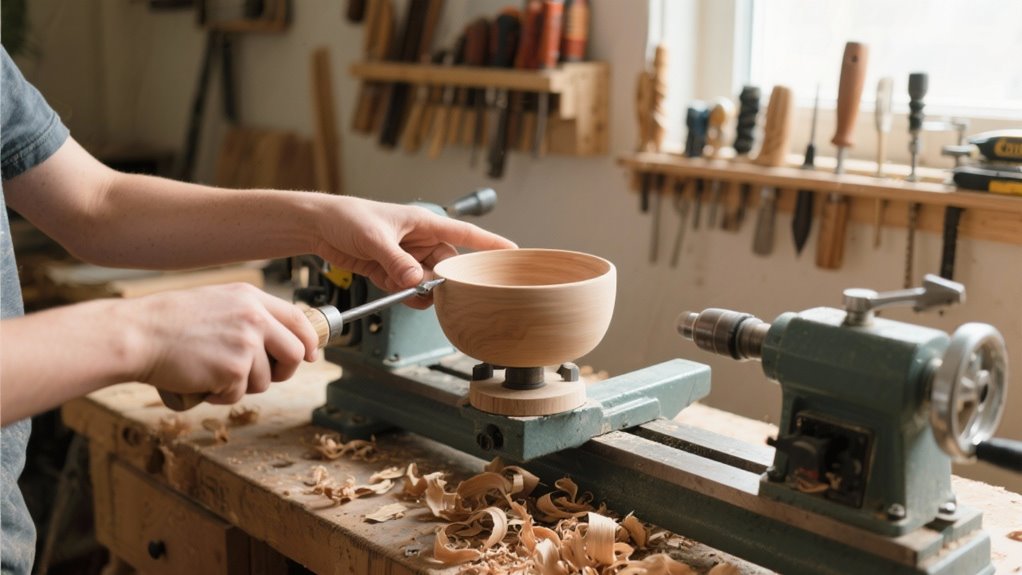
Now let’s look at what you should consider when buying your first lathe. Many woodworkers find that beginners should pay attention to power requirements, size and weight, speed control options, work capacity, and tool rest design—each factor will greatly impact your woodturning experience. You’ll want to balance these considerations with your available space, budget, and the types of projects you’re planning to tackle.
Power Requirements
Understanding your lathe’s power requirements might sound technical, but it’s actually one of the most significant factors that’ll determine your success as a beginner woodworker.
Most beginner lathes range from about 100 watts to 6 amps, and honestly, we’d recommend going for a bit more power if you can afford it. Higher wattage means better torque, which is vital when you’re working with denser woods – nobody wants a stalling lathe mid-project!
Look for models with variable speed settings – ideally between 250 to 10,000 RPM. This versatility is, well, kind of essential for different projects. You’ll want to start slow while you’re learning, then crank things up as you gain confidence.
Don’t forget to check that your home’s electrical supply (probably 110 volts) matches your new lathe’s requirements.
Size and Weight
When selecting your first lathe, size and weight shouldn’t be afterthoughts—they’re actually essential factors that’ll determine both your comfort level and the projects you can tackle.
For beginners, many woodworkers find that smaller lathes handling pieces up to 12-14 inches wide and 18-20 inches long are ideal starting points. If you’re working in a tight space, look for compact models around 13-15 inches in length—they’ll fit nicely in smaller workshops without sacrificing functionality.
Weight is, well, a bit of a balancing act. Lighter lathes (about 70-90 pounds) are easier to move around as you’re setting up your workspace, but heavier models provide more stability during turning. Think of it like choosing shoes—you want something that fits your space while providing the right support for your journey into woodturning.
Speed Control Options
Many woodworkers find that beginners really benefit from lathes with variable speed settings, typically ranging from 250 to 3550 RPM.
Look for models with multiple adjustable options—maybe a 5-speed or 7-speed configuration. This flexibility is, well, kinda like having different gears on a bike. You’ll want to start slow (safer that way!) and gradually work up as your confidence grows.
In our experience, a wider speed range opens up more possibilities for your projects. And don’t forget about stability—a heavier, solid lathe will minimize those annoying vibrations when you’re cranking up the speed.
Work Capacity
Two key measurements will determine everything you can create on your lathe: swing and bed length. The swing tells you the maximum diameter your lathe can handle—think bowls and round projects—while the bed length determines how long your workpieces can be.
For beginners, we recommend looking for a lathe that can accommodate at least 14 inches in width and 20 inches in length. This gives you plenty of room to grow. If you’re mostly interested in creating small decorative items, you might be fine with less, but honestly, it’s frustrating to outgrow your equipment too quickly.
Don’t forget about construction quality, either. A heavier, sturdier lathe will give you more stability when you’re working on larger projects, which, makes a huge difference in your results.
Tool Rest Design
While many beginners overlook it, a quality tool rest design can make or break your woodturning experience. Many woodworkers find that longer tool rests provide much better support when you’re working on larger pieces, helping you achieve those smooth, controlled cuts that are otherwise frustratingly difficult.
Don’t skimp on material quality here—cast iron tool rests drastically reduce vibration, which, you’ll appreciate during those longer turning sessions. The locking mechanism is probably the most critical feature; it needs to hold firm when you’re applying pressure.
We always recommend adjustable rests for beginners. You’ll definitely want the flexibility to change angles and heights as you tackle different projects and, well, develop your personal turning style.
Budget Considerations
When planning your woodworking journey, setting a realistic budget is absolutely critical—you can’t stress this enough. For beginners, we typically recommend allocating between $150-$500 for your first lathe. But wait—don’t forget about the accessories!
You’ll need to factor in an additional $100-$300 for essential tools and accessories that, you’re definitely going to need. It’s like buying a car without gas—the lathe alone won’t get you turning.
Also, consider future maintenance costs. Some cheaper models might seem like a bargain up front but end up costing more in replacement parts down the road. We always suggest looking for models with solid warranties. Compare features carefully—sometimes spending just a bit more initially saves a ton of headaches later.
Conclusion
Wrapping Up Our Lathe Journey
Well folks, we’ve whittled our way through the woodturning wilderness and uncovered some real standouts for those just starting out. A beginner lathe isn’t just equipment—it’s your creative companion as you learn to transform raw timber into something magical.
The WEN 34035 shines as an all-rounder with enough power and features to keep you happy from your first spindle to more complex projects down the road. Meanwhile, the Mini Lathe proves that good things really do come in small packages for those with limited workshop space.
My advice? Don’t overthink it. Pick the lathe that matches your space, budget, and the projects you’re itching to try. Then just dive in—your first bowl might look more like a wonky frisbee, but that’s part of the journey!
Ready to make some sawdust? Grab one of these beginner-friendly lathes, fire up some YouTube tutorials, and start turning. Your future self (and your holiday gift recipients) will thank you.
Related guides: 9 Best Clamps for Edge Gluing That Woodworkers Swear By · 5 Best Routers for Small Woodworking Projects, According to Professional Woodworkers