As an Amazon Associate, we earn from qualifying purchases. Some links in this article are affiliate links.
Some of the links in this article may be affiliate links. If you make a purchase through these links, we may earn a small commission at no extra cost to you. Thank you.
You need something that keeps pressure steady and lasts through years of use. But here’s the thing: not all regulators handle moisture the same way, and some gauges are harder to read than others. We’ll walk you through what actually matters when you’re picking one out.
| Air Compressor Pressure Regulator with Dial Indicator (4-way) | Most Versatile | Maximum Pressure Rating: 175 PSI | Connection Type: 4-way valve | Pressure Gauge: 0-175 PSI dial indicator | VIEW LATEST PRICE | In Depth | |
| NANPU 1/4″ NPT Compressed Air Filter Regulator Combo |  | Best Overall | Maximum Pressure Rating: 145 PSI | Connection Type: 1/4″ NPT connection | Pressure Gauge: 0-150 PSI gauge | VIEW LATEST PRICE | In Depth |
| Hromee 1/4 Inch Air Compressor Filter Regulator Combo | 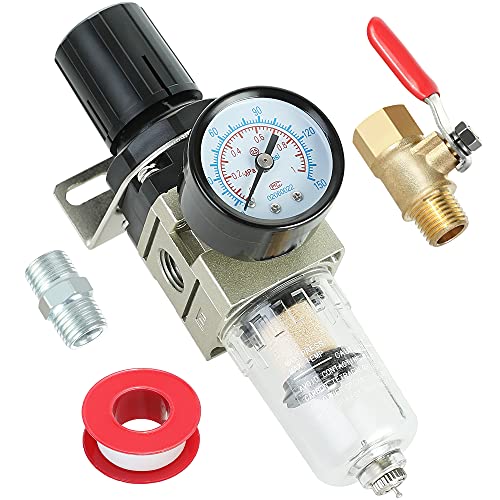 | Best Value | Maximum Pressure Rating: 150 PSI | Connection Type: 1/4″ NPT connection | Pressure Gauge: 0-150 PSI dual-unit gauge (PSI/MPa) | VIEW LATEST PRICE | In Depth |
More Details on Our Top Picks
Air Compressor Pressure Regulator with Dial Indicator (4-way)
Looking for a regulator that won’t break the bank but still gets the job done? The FBANG Air Compressor Pressure Regulator with Dial Indicator handles it well. This 4-way valve reads pressure up to 175 PSI and lets you adjust airflow with a simple knob. It’s made from zinc alloy and copper, so it’s built tough. Installation takes minutes—just screw it on and go. You get a dial gauge to monitor pressure in real time. The regulator works without batteries or external power, making it practical for daily pneumatic tool use. At 13.1 ounces, it’s lightweight and portable.
- Maximum Pressure Rating:175 PSI
- Connection Type:4-way valve
- Pressure Gauge:0-175 PSI dial indicator
- Weight:13.1 ounces
- Primary Materials:Plastic, zinc alloy, copper
- Return Policy:Amazon return policy available
- Additional Feature:4-way valve configuration
- Additional Feature:Includes thread locking agent
- Additional Feature:No external power required
- Connection Type:3 holes design
- Pressure Gauge:No gauge specified
- Weight:3.7 ounces
- Primary Materials:Metal
- Return Policy:30-day voluntary return
- Additional Feature:Compatible with multiple brands
- Additional Feature:Lightweight portable design
- Additional Feature:3 holes design
- Connection Type:4-port regulator
- Pressure Gauge:Dual chamber pressure reading
- Weight:4.8 ounces
- Primary Materials:Metal alloy
- Return Policy:Amazon 30-day voluntary return guarantee
- Additional Feature:Dual chambers tank/line
- Additional Feature:140 cubic feet per minute
- Additional Feature:4-port regulator configuration
NANPU 1/4″ NPT Compressed Air Filter Regulator Combo
NANPU’s combo unit works best for folks who want filtering and regulation in one compact package. You get a 5-micron brass element that cleans your air, plus a regulator that keeps pressure steady between 0-125 psi. The polycarbonate bowl lets you see moisture buildup, and the semi-auto drain saves you time. It handles 20 SCFM at 90 psi, which is solid for most workshop tools. The gauge reads up to 150 psi, so you’ll always know what you’re working with. Everything’s mounted on a metal bracket for easy installation.
- Maximum Pressure Rating:145 PSI
- Connection Type:1/4″ NPT connection
- Pressure Gauge:0-150 PSI gauge
- Weight:14.4 ounces
- Primary Materials:Brass element, polycarbonate bowl
- Return Policy:No return policy specified
- Additional Feature:5 micron brass element
- Additional Feature:Semi-auto drain feature
- Additional Feature:20 SCFM flow rate
Hromee 1/4 Inch Air Compressor Filter Regulator Combo
For folks working in tight spaces or needing a compact filtration setup, Hromee’s 1/4 inch combo unit packs both filter and regulator into one piggyback design. The brass filter element removes moisture and fine particles, keeping your tools and equipment protected. You get an adjustable pressure control knob so you can set your desired outlet pressure. The dual-unit pressure gauge shows readings in both psi and MPa up to 150 PSI. A forged brass ball valve resists corrosion, and the included bracket makes mounting straightforward. At just 12 ounces, this combo won’t take up much room in your workshop. It works well for air brushing and general pneumatic equipment.
- Maximum Pressure Rating:150 PSI
- Connection Type:1/4″ NPT connection
- Pressure Gauge:0-150 PSI dual-unit gauge (PSI/MPa)
- Weight:12 ounces
- Primary Materials:Aluminum, brass, polycarbonate
- Return Policy:30-day return policy via Amazon
- Additional Feature:Water oil separator included
- Additional Feature:Forged brass ball valve
- Additional Feature:Manual drain valve
Factors to Consider When Choosing an Air Compressor Regulator
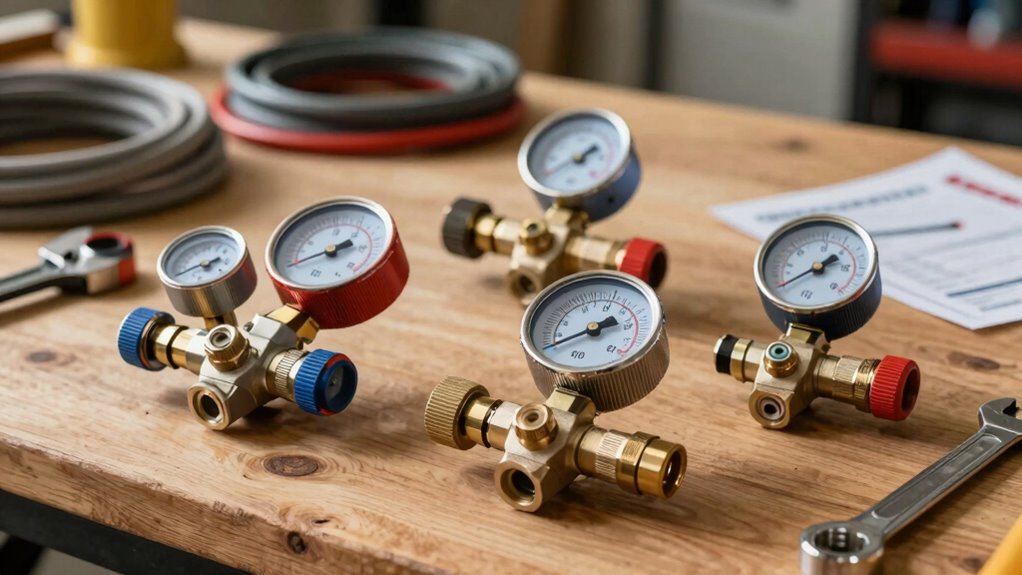
Before you pick a regulator, you’ll want to check the maximum pressure it can handle and make sure it works with your specific compressor model. The port size and how the regulator connects matter too—you need the right fit so air flows smoothly without leaks. And don’t skip material quality, since a durable regulator built to last will save you money and headaches down the road.
Maximum Pressure Ratings
Why does maximum pressure rating matter so much? We need to match our regulator to what our compressor can handle. If we pick one that’s too weak, it won’t work right. If we pick one that’s too strong, we might damage our tools or hoses.
Most consumer regulators handle between 100 and 175 PSI. We should check both the PSI and bar measurements to make sure we’re getting the right fit. The regulator’s maximum setting should meet our needs without going over what the system can take.
Pushing past the maximum rating causes real problems. Seals get damaged. The regulator loses accuracy. Parts wear out faster. We’re better off staying within the limits and keeping everything working properly.
Compatibility With Compressors
Getting the right regulator means matching it to your actual compressor setup. We need to check the thread sizes first. Your regulator’s inlet and outlet must match your compressor’s fittings. Common sizes are 1/4″ NPT, but yours might differ.
Next, verify the regulator’s maximum pressure rating. It should exceed what your compressor produces. If it doesn’t, you’ll get restriction or damage.
If your system has powered components, confirm voltage requirements match. A 12V regulator won’t work on a 24V system.
Port configuration matters too. Some regulators have 2 ports while others have 4. Check your compressor’s air flow needs and plumbing layout.
Finally, certain regulators work only with specific compressor models. Always verify compatibility before buying. Taking time upfront saves headaches later.
Port Configuration Types
Port layout is where things get practical. We need to match our regulator’s ports to our hose fittings and available mounting space. Most regulators use standard 1/4″ NPT connections, which makes finding compatible accessories easier.
Four-port setups are common because they balance size with functionality. They let us feed multiple tools or circuits from one regulator without constantly switching hoses. A 4-way valve configuration gives us independent control of line pressure and tank pressure, so we can handle different tasks without swapping equipment.
Before buying, check your existing hoses and fittings. Wrong port sizes cause cross-threads and leaks. Taking time to verify compatibility saves us frustration and money down the road.
Material Quality And Durability
What separates a regulator that lasts years from one that fails after months? Material quality. We recommend looking for metal bodies or zinc alloy components. These resist wear and corrosion under pressure way better than plastic alone. A brass or aluminum gauge housing is ideal because it handles impact and vibration without breaking down. If plastic parts are included, they should be rated for both pressure and temperature to prevent cracking over time. Don’t overlook thread sealing solutions either. A good thread locking agent keeps leaks from happening and maintains consistent regulation. Multi-port designs distribute pressure evenly, which reduces stress on individual components. When you invest in solid materials upfront, you’re buying durability and reliability that actually pays off.
Flow Rate Capacity
Why does flow rate matter so much? Your regulator needs to handle the air volume your tools actually demand. We’re talking CFM or SCFM—that’s how we measure it.
If your regulator can’t push enough air through, your tools won’t perform well. You’ll get pressure drops that slow everything down. On the flip side, matching flow capacity to your compressor prevents over-pressurization.
Think about what you’re doing. Running one tool? You need less capacity. Using multiple tools at once? You’ll need higher flow ratings.
The regulator’s internal design matters too. Bigger passages and smoother valve designs let air move more freely. That means better performance with less resistance.
Check both the maximum flow rating and your typical working pressure. They work together to keep things running smoothly.
Gauge Accuracy And Readability
Getting the right flow rate matters, but you also need to know what pressure you’re actually working with. A clear gauge with large, high-contrast numbers lets you read pressure at a glance without mistakes. We recommend looking for analog dial gauges with fine graduations—think 1 to 2 PSI increments—so you can set and monitor pressure precisely.
Durability matters too. A protective metal shell and shatter-resistant window keep your gauge working accurately through impacts and vibration. Over time, gauge faces can stretch or get foggy, so regular calibration or replacement keeps measurements reliable.
Some regulators use dual-scale gauges showing both PSI and BAR. That’s useful for cross-checking, but make sure the labels are clear. Misreading your pressure scale creates real problems on the job.
Installation And Mounting Options
How you mount your regulator affects everything—accessibility, vibration control, and how well it integrates with your setup. We need to consider whether we’re dealing with a 4-way or 2-stage configuration, since each has different space requirements on the compressor or line. Some regulators come with mounting brackets or kits that let us attach them securely to a wall, bench, or directly to the compressor body. Thread size matters too—most use 1/4″ NPT fittings, but you might need adapters. Compact piggyback designs combine filter and regulator in one unit, so we need to account for that combined footprint. Materials like metal versus plastic affect stability and debris protection. Pick a mounting option that keeps your setup organized and reduces vibration.
Operating Temperature Range
Temperature swings can wreck your regulator’s performance if you’re not careful. Most regulators work best within a specific range, typically 41–140°F or 5–60°C. Outside these limits, things go wrong fast.
Heat and cold affect your regulator’s internal parts. Seals can crack. O-rings lose flexibility. Lubricants thicken or thin out. Your outlet pressure starts drifting, and accuracy drops. Gauge readings become unreliable too.
This matters most if you’re working outdoors or near heat sources like compressor exhausts. Even occasional temperature spikes beyond the rated range cause premature wear.
Pick a regulator rated for your actual conditions. Check the temperature limits before buying. Match it to where you’ll actually use it. That’s the best way to avoid headaches and keep your system running reliably.
Related guides: 7 Best Air Filtration Systems for 2026{slug=best-air-filtration-system}{author=CurtisMain} · 10 Best Air Compressor Oils for 2026{slug=best-air-compressor-oil}{author=wpsbadmin} · 14 Best Air Compressor Hoses for 2026