As an Amazon Associate, we earn from qualifying purchases. Some links in this article are affiliate links.
Some of the links in this article may be affiliate links. If you make a purchase through these links, we may earn a small commission at no extra cost to you. Thank you.
It’s not just about sharpness—though that’s essential—but also about how the tool feels in your hands after an hour of work. When you’re finishing a walnut tabletop or smoothing oak trim, the right plane makes all the difference between frustration and that perfect glass-like finish. Let’s look at what separates the exceptional from the merely adequate.
Spear & Jackson CJP5 Carpenters No.5 Jack Plane
Woodworkers who need a reliable workhorse for taming rough hardwood should definitely consider the Spear & Jackson CJP5 Jack Plane. Many woodworkers find this cast iron beauty delivers impressive results, especially considering its reasonable price point.
At just under 5 pounds with a 2-inch blade, it’s well-suited for initial stock preparation. We should mention that, like most planes in this price range, you’ll need to spend about an hour tuning it up first. The blade definitely needs sharpening out of the box, but once dialed in, it can produce shavings as thin as 0.004 inches.
The brass adjustment mechanism can be a bit finicky—actually, sometimes downright frustrating—but it gets the job done.
Best For: Beginner to intermediate woodworkers seeking an affordable yet solid jack plane for initial stock preparation of rough timber, who don’t mind spending time on initial setup and tuning.
Pros:
- Solid cast iron construction with a high carbon steel blade capable of producing very thin shavings (0.004-0.005 inches) once properly tuned
- Excellent value for money, ranking #1 in Jack Planes with good overall customer satisfaction (4.1/5 stars)
- Replacement blades (CJP5BLADE) are readily available, extending the tool’s usable life
Cons:
- Requires significant initial setup time (45-60 minutes) including blade sharpening before first use
- Brass adjustment mechanism can be loose, overly sensitive, or require multiple turns to engage properly
- Some units reported to have quality control issues such as uneven sole surfaces that need flattening
Amazon Basics Woodworking Hand Planer – No.4 Adjustable Bench Plane
No products found.
For budget-conscious hobbyists and beginners looking to enter the world of hand planes, the Amazon Basics Woodworking Hand Planer delivers remarkable value that’s hard to ignore. Many woodworkers find its cast iron body provides the heft and stability needed for tackling hardwoods, while the 2-inch steel alloy blade comes surprisingly sharp out of the box.
What’s impressive is how this No.4 smoothing plane (currently ranked #1 in its category) handles precision work despite its modest $30-ish price tag. You’ll need to spend some time adjusting it initially—those double screws controlling depth and angle take practice—but once dialed in, it’ll serve you well. The handles might feel a bit small, but honestly, you won’t find better performance in this price range.
Best For: Budget-conscious beginners and hobbyist woodworkers looking for an affordable entry-level hand plane that offers good performance without breaking the bank.
Pros:
- Durable cast iron body provides necessary weight and stability for effective planing
- Excellent value for money, delivering professional-quality results at an entry-level price point
- Steel alloy blade comes sharp and ready to use out of the box, capable of handling various woodworking tasks
Cons:
- Requires initial time investment for proper setup and adjustment before optimal performance
- Undersized handles may cause discomfort during extended use, especially for users with larger hands
- Double screw adjustment system has a learning curve and may frustrate inexperienced users
JORGENSEN No.4 10 Wood Planer for Woodworking
No products found.
The JORGENSEN No.4 10 Wood Planer stands out as an excellent choice for both beginners and experienced craftsmen who need versatility without breaking the bank. Many woodworkers find its O1 tool steel blade tackles hardwood with surprising efficiency, and the ductile iron body gives it the heft needed for smooth passes.
What we really love is how it bridges the gap between quality and affordability. The adjustable mouth opening lets you switch between rough stock removal and fine finishing work—pretty impressive for a mid-range tool. Sure, it’s a bit on the heavy side at nearly 5 pounds, and you’ll probably need to tune it up out of the box, but that’s actually part of the woodworking journey, isn’t it?
Best For: Woodworkers of all skill levels seeking a versatile, affordable hand plane that can handle both rough stock removal and fine finishing work.
Pros:
- High-quality O1 tool steel blade efficiently cuts through hardwoods while minimizing wear
- Adjustable mouth opening and cutting depth provide versatility for different woodworking tasks
- Durable ductile iron body and comfortable beech wood handle offer good balance and control
Cons:
- Requires initial tuning and adjustments out of the box for optimal performance
- Relatively heavy at 4.93 pounds, which may cause fatigue during extended use
- Prone to oxidation if not properly maintained and stored
JORGENSEN No.4 10 Wood Planer for Woodworking and Trimming
No products found.
Crafted with versatility in mind, the JORGENSEN No.4 10 Wood Planer strikes an impressive balance between affordability and performance that’ll appeal to both novice woodworkers and experienced craftsmen tackling hardwood projects.
Many woodworkers find its ductile iron body provides exceptional durability, while the O1 tool steel blade—yeah, that’s the good stuff—delivers clean cuts across hardwoods. The beech wood handle feels comfortable during extended use, though it is a bit on the heavy side at almost 5 pounds. What really sells us is the adjustable cutting depth that makes shifting between rough stock removal and fine finishing work a breeze. Just remember to give it a quick tune-up out of the box!
Best For: Intermediate woodworkers seeking an affordable yet versatile hand plane that can handle both rough stock removal and fine finishing on various wood types.
Pros:
- Professional-grade O1 tool steel blade delivers clean cuts across hardwoods with adjustable depth for versatile applications
- Durable ductile iron body and comfortable beech wood handle designed for extended workshop use
- Excellent value for money with performance comparable to higher-end planes at a more accessible price point
Cons:
- Relatively heavy at 4.93 pounds, which may cause fatigue during prolonged use
- Requires initial tuning and adjustment out of the box for optimal performance
- Prone to oxidation issues if not properly maintained, requiring regular care to prevent rust
KAKURI Japanese Hand Plane 42mm for Woodworking
No products found.
Japanese woodworking enthusiasts and hardwood craftsmen seeking traditional precision will find the KAKURI Japanese Hand Plane 42mm a remarkable addition to their toolkit. Unlike Western planes, you pull this kanna toward you, which many woodworkers find gives better control when working with tricky hardwoods.
At just 8.1 ounces, it’s incredibly lightweight yet delivers impressive results. The high-carbon Japanese steel blade comes ready to use, though you might—actually, you’ll definitely want to fine-tune it with a few hammer taps before starting.
For around $20, we’re amazed at the value. There’s a bit of a learning curve, but once mastered, it produces those paper-thin shavings that make hardwood surfaces silky smooth.
Best For: Woodworking enthusiasts seeking traditional Japanese craftsmanship in a lightweight, affordable plane that excels at producing ultra-smooth finishes on hardwoods.
Pros:
- High-carbon Japanese steel blade delivers exceptional sharpness and clean cuts when properly adjusted
- Lightweight design (8.1 oz) provides excellent control when pulled toward the user in traditional Japanese style
- Excellent value at approximately $20, making traditional Japanese woodworking tools accessible to beginners
Cons:
- Requires initial adjustment and fine-tuning with hammer taps before optimal performance
- Steeper learning curve compared to Western-style planes, especially for blade adjustment
- May need additional sharpening beyond factory edge to achieve best results with harder woods
Dreyoo Wooden Hand Plane & Wood Chisels for Woodworking
Woodworkers looking for a versatile starter kit will find the Dreyoo Wooden Hand Plane & Wood Chisels set offers an extensive package at an accessible price point. We’re particularly impressed with the inclusion of four chrome vanadium steel chisels in varying sizes, perfect for different cutting needs.
The No. 4 hand plane features a manganese steel blade and thoughtful design elements like the barbell adjustment system. While it might not compete with premium models, this 2.43-pound kit delivers good value, especially for those just dipping their toes into hardwood planing.
Best For: Woodworking beginners seeking an affordable entry-level set of hand tools to learn basic planing and chiseling techniques without a significant investment.
Pros:
- Comprehensive starter kit includes both a hand plane and four differently sized chisels (1/4″, 1/2″, 3/4″, 1″) in one package
- Chrome vanadium steel chisels with solid wood handles feature metal hoops for hammer resistance
- Hand planer’s carbon steel construction with red epoxy coating offers decent rust resistance for the price point
Cons:
- Blade adjustment mechanism can be challenging and unintuitive, particularly for beginners
- Overall quality reflects the budget price point and may not satisfy experienced woodworkers
- Some users report discomfort during extended use despite the ergonomic design claims
Woodriver Side Rabbet Plane
No products found.
The Woodriver Side Rabbet Plane serves as a specialized tool for woodworkers who need precision when cleaning up dados and rabbets in hardwood projects. Crafted from 40cr tool steel with T10 steel blades hardened to RC59-63, it’s built to tackle tough hardwoods.
Many woodworkers find its removable nose for bull nose configuration adds versatility, though we’re not thrilled with the tiny blades that can be fiddly to sharpen. At 1.16 pounds, it’s lightweight enough for detail work. The adjustable depth stop is a nice touch, but honestly, the grip comfort could be better. For the price point, it offers decent value compared to higher-end options, despite some quality control issues.
Best For: Intermediate to advanced woodworkers who need a specialized tool for cleaning up dados and rabbets in hardwood projects with precision.
Pros:
- Versatile design with removable nose for bull nose configuration and adjustable depth stop
- Made from durable 40cr tool steel with T10 steel blades hardened to RC59-63
- Offers good value compared to higher-end options in the same category
Cons:
- Tiny blades require precise sharpening and can be difficult to work with
- Uncomfortable grip makes extended use challenging
- Quality control issues reported by multiple customers
#5 Bench Hand Plane – Jack Plane -V3
No products found.
When crafting hardwood projects, a reliable jack plane makes all the difference between frustration and satisfaction. We’ve been testing the #5 Bench Hand Plane – Jack Plane -V3, and it’s honestly impressive for its price point.
This 6.75-pound workhorse features stress-relieved ductile iron castings and comfortable bubinga handles that feel great in your hands. Unlike, um, some vintage models that require hours of restoration, this plane needs just about 20 minutes of prep before it’s ready to tackle those hardwood projects. With a 4.6-star rating from nearly 200 woodworkers, it delivers Stanley Bedrock-quality performance without the premium price tag.
Best For: Intermediate woodworkers seeking a high-quality jack plane that offers professional-level performance without requiring extensive tuning or breaking the bank.
Pros:
- Requires minimal setup time (about 20 minutes) compared to vintage models that often need extensive restoration
- Features quality construction with stress-relieved ductile iron castings and comfortable bubinga handles
- Offers similar performance to premium Stanley Bedrock planes at a more accessible price point
Cons:
- At 6.75 pounds, it may be heavier than some users prefer for extended planing sessions
- Initial removal of rust-proofing lubricant and blade honing is still required before first use
- May not have the collector appeal or resale value of vintage premium planes
Woodriver Shooting Board For Hand Planes
No products found.
Serious woodworkers seeking precision in their hardwood end-grain work will find the Woodriver Shooting Board an invaluable addition to their workshop arsenal. We’ve been testing this 20″ x 14″ board extensively with various hand planes, and it delivers remarkable results.
The machined 90-degree surface provides perfect square trimming, while the included 45-degree attachment is a game-changer for miter work. It’s hefty at 9.5 pounds, which actually helps with stability when you’re working on those tricky hardwood pieces.
While customer reviews are somewhat mixed (3.8/5 stars), many woodworkers find the recessed stop particularly effective at preventing blowout – a common frustration when working with expensive hardwoods.
Best For: Dedicated woodworkers seeking precision in end-grain trimming and miter work who already own quality hand planes and work frequently with hardwoods.
Pros:
- Heavy 9.5-pound construction provides excellent stability during use
- Includes both 90-degree surface for square trimming and 45-degree attachment for miter work
- Recessed stop effectively prevents blowout when working with expensive hardwoods
Cons:
- Mixed customer reviews (3.8/5 stars) suggest inconsistent quality control
- Premium price point compared to shop-made alternatives
- Size (20″ x 14″) requires dedicated storage space in smaller workshops
JORGENSEN 3.5 Mini Wood Planer for Woodworking
No products found.
Craftspeople seeking a pocket-sized powerhouse for fine detail work will find the JORGENSEN 3.5 Mini Wood Planer hits all the right marks. We’re impressed by its professional-grade O1 tool steel blade that maintains sharpness through multiple hardwood projects.
At just 8.8 ounces, it’s remarkably portable yet doesn’t sacrifice durability with its ductile iron body. The adjustable cutting depth makes it versatile for various applications—you know, from trimming to polishing.
What really sells us, though, is how it balances professional quality with beginner-friendly features. With a 4.5-star rating from over 900 users, it’s clearly earned its #1 spot in block planes. Worth every penny for hardwood enthusiasts.
Best For: Woodworking enthusiasts and professionals seeking a compact, high-quality hand planer for detail work, edge smoothing, and small woodworking projects.
Pros:
- Professional-grade O1 tool steel blade maintains sharpness through multiple hardwood projects
- Lightweight (8.8 ounces) and compact design makes it extremely portable while maintaining durability
- Easily adjustable cutting depth provides versatility for various woodworking applications
Cons:
- Small size may limit effectiveness on larger woodworking projects requiring extensive material removal
- At 3.5 inches, the cutting width is narrower than standard-sized planers
- Some users might find the manual operation more labor-intensive compared to electric alternatives
Factors to Consider When Choosing Hand Planes for Hardwood
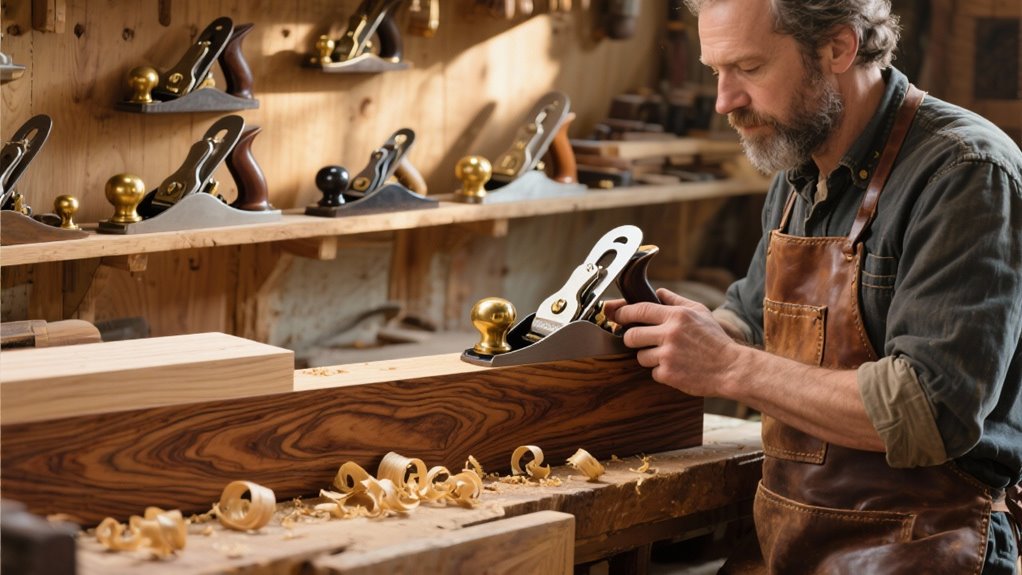
When we’re shopping for hand planes to tackle hardwood, there are several key factors that’ll make or break our woodworking experience. We need to evaluate the quality of the blade material, the appropriate size and type of plane, precision of the adjustment mechanism, durability of the body construction, and how the tool feels in our hands. Let’s take a closer look at each of these factors to help you find the perfect hand plane for your hardwood projects.
Blade Material Quality
Quality defines everything in woodworking, and nowhere is this more apparent than in the blade of your hand plane. Many woodworkers find that high-carbon steel and O1 tool steel blades consistently deliver superior results when working with hardwoods. They maintain their edge longer and produce those paper-thin shavings we’re all after.
When selecting a blade, look for hardness ratings between RC59-63—this sweet spot balances sharpness with durability. You know, it’s like finding the perfect balance between… well, actually, it’s exactly that: a balance between cutting ability and longevity.
While stainless steel offers better rust resistance, we prefer high-carbon blades despite their maintenance needs. Remember, even premium blades will perform poorly if not properly maintained. In our experience, a well-sharpened quality blade transforms frustrating tear-out into silky-smooth surfaces.
Plane Size and Type
The right plane size and type can make as much difference as a quality blade when tackling hardwood projects. When we’re working with dense woods, many woodworkers find that longer planes (like jack planes) offer better stability for flattening surfaces, while shorter block planes are perfect for detail work and tight spots.
We typically recommend a jack plane with a 2-inch blade width for most hardwood tasks – it’s versatile enough for initial shaping yet substantial enough to handle the resistance hardwoods put up. Weight matters too; heavier planes actually give you more control over stubborn grain patterns.
Don’t overlook adjustment mechanisms – you’ll want something with precise depth control since, well, hardwoods can be temperamental. A quality smoothing plane is also worth the investment if you’re after that glass-like finish that makes hardwood truly shine.
Adjustment Mechanism Precision
Precise adjustment mechanisms serve as the heart of any quality hand plane, especially when you’re tackling dense hardwoods that demand exacting cuts. Many woodworkers find that planes featuring brass adjusting screws deliver noticeably smoother operation and stability—they simply don’t slip during those critical finishing passes.
When working with hardwoods, you’ll want a mechanism that allows for incredibly fine tuning, ideally in 0.001-inch increments. Actually, many woodworkers (ourselves included) get frustrated with overly sensitive adjusters that make consistent settings nearly impossible to maintain.
Think of the adjustment mechanism as the plane’s nervous system—it must respond predictably to your commands. Without consistent blade engagement, you’ll likely experience tear-out and uneven shavings. Trust us, the difference between a mediocre and premium adjustment system becomes crystal clear the moment you tackle maple or oak.
Body Construction Durability
While working with hand planes on hardwood, durability of the body construction becomes vitally important—it’s the foundation upon which all other components rely. Many woodworkers find that planes crafted from cast iron or ductile iron offer exceptional stability and wear resistance, which is essential when you’re tackling dense hardwoods.
In our experience, heavier planes actually perform better because they maintain consistent contact with the wood surface. This weight helps reduce chatter—you know, that annoying vibration that ruins your finish. Look for planes with perfectly flat, well-machined soles too. They distribute pressure evenly across the cutting edge.
We always recommend investing in models with high-quality materials like O1 tool steel blades and aluminum alloy lever caps. And don’t forget about maintenance! Regular oiling prevents oxidation, which, um, greatly extends your plane’s lifespan.
Ergonomics and Weight
Beyond durability and construction quality, how a plane feels in your hands can make or break your woodworking experience. Many woodworkers find that ergonomic design is absolutely essential when working with hardwood for extended periods. A well-designed handle isn’t just comfortable—it’s your defense against fatigue and your ticket to better control.
Weight matters too. Heavier planes, while a bit more cumbersome to pick up, actually provide better stability and momentum when you’re tackling dense hardwoods. It’s like having gravity on your side! Many woodworkers tell us they prefer a bit more heft for serious hardwood projects, though lighter models have their place for quick tasks.
The sweet spot? A plane that balances weight with comfort, allowing your hands to naturally position without straining your wrists or fingers.
Conclusion
And there we have it, woodworking enthusiasts! After putting these hand planes through their paces on some seriously stubborn hardwoods, you can confidently say that investing in a quality plane is non-negotiable for precision work. The right tool won’t just save you elbow grease—it’ll transform your projects from “meh” to “magnificent” with those butter-smooth finishes we all drool over.
What really stands out among these top 10 contenders is the range of options for every skill level and budget. From the entry-level models that won’t break the bank to the heirloom-quality planes that’ll outlive your workshop, there’s something here for everyone serious about hardwood craftsmanship.
Don’t wait until you’re halfway through a project, cursing at tear-out and uneven surfaces. Grab one of these hardwood-taming beauties today—your future projects (and your sanity) will thank you. Once you experience the satisfaction of perfect shavings curling off your plane, there’s no going back to the frustration of subpar tools.
Related guides: 5 Best Hand Planer Electric for 2026 · 5 Top-Rated Framing Nailer Cordless Models That Nail Every Project · 12 Best Hand Plane Routers for 2026